NHS Sales Intelligence
NHS AI Governance & Ethics: Frameworks, Approvals, and What to Cite
Understand how NHS Trusts approve AI, and reference the right frameworks in your pitch.
NHS Trusts have governance processes for AI adoption, including ethics boards, data protection reviews, and clinical safety assessments. This guide explains what they are and how to cite them in your outreach.
No credit card required · 300+ NHS Trusts monitored
What you need to know
Data Protection Impact Assessments (DPIAs)
Every NHS Trust running an AI project must complete a DPIA before processing patient data. Board papers often reference DPIA status, which tells you how far along a trust is in their AI approval pipeline and whether they are ready to engage with vendors.
Ethics boards and clinical safety sign-off
Most Trusts route AI proposals through a clinical safety officer or an ethics advisory group. Board papers name these bodies and record their recommendations, giving you the exact language the trust uses to evaluate AI products.
DCB0129 and DCB0160 compliance
Clinical safety standards DCB0129 (manufacturer) and DCB0160 (deploying organisation) are mandatory for health IT. When board papers reference these standards, it signals a trust that takes AI governance seriously and has a formal pathway for adoption.
NHS AI Lab and national frameworks
Trusts frequently cite the NHS AI Lab, NICE Evidence Standards Framework, or the Algorithmic Transparency Recording Standard. Mentioning these in your pitch shows you understand the regulatory environment the trust operates within.
Interactive Demo
See how it works
Explore a sample analysis using fictional data. Click through the tabs to see how we turn an NHS board paper into actionable sales intelligence.
Platform
Analyses this Cycle
Demo User
demo@medtech.co.uk
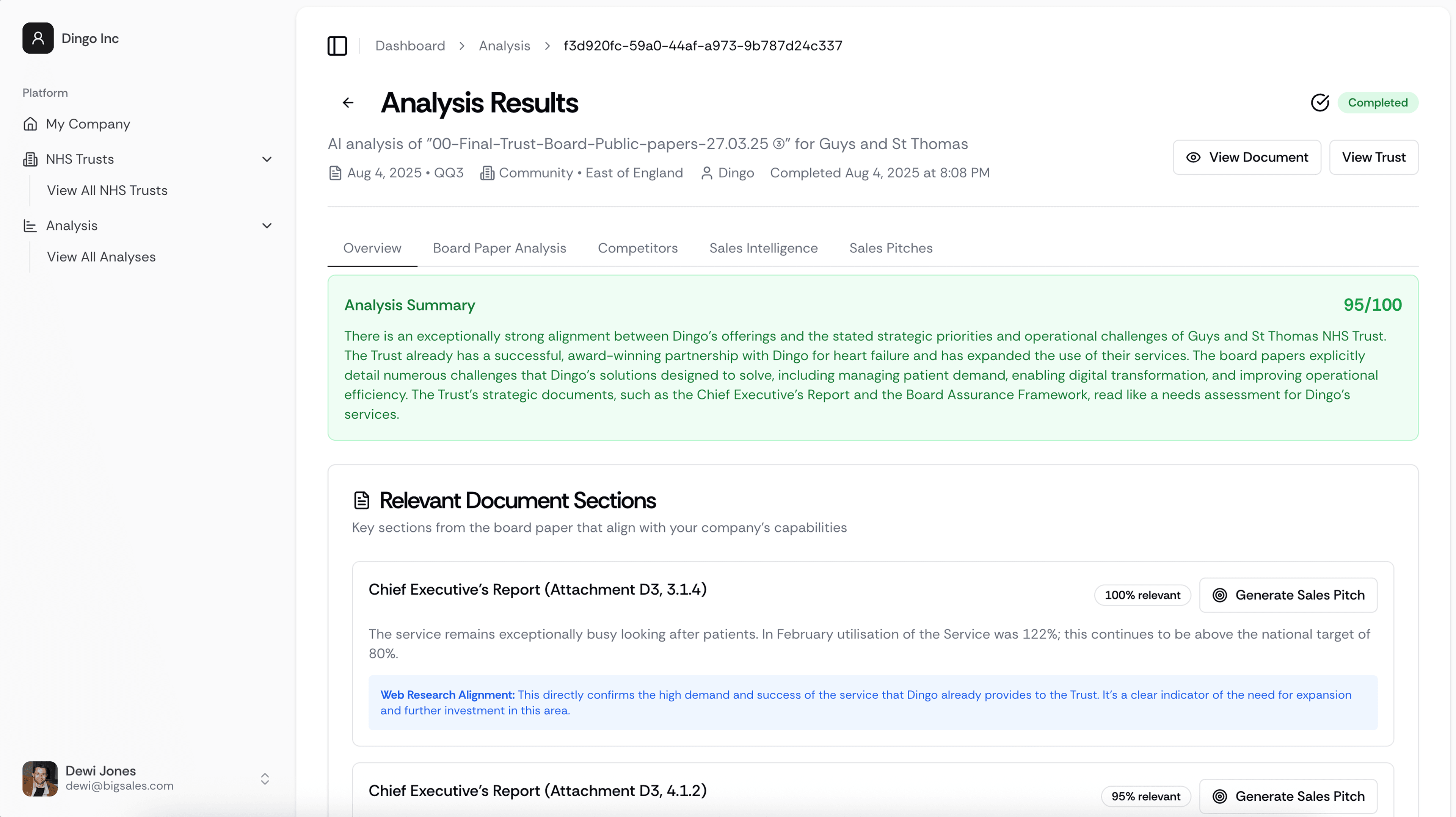
Analysis Results
AI analysis of “Board of Directors Meeting, Sample” for Example NHS Trust
Analysis Summary
78/100Strong alignment found. Example NHS Trust has explicitly committed to digital transformation of patient pathways, with a £12M budget allocated for 2025/26. Your patient flow optimisation platform directly addresses their stated priority of reducing elective care waiting lists.
Theme Analysis
Findings grouped by your company's strategic themes
Digital Patient Pathways
The Trust has committed to a complete overhaul of patient pathways using digital-first approaches. The board paper outlines specific goals around theatre scheduling, outpatient management, and real-time bed tracking.
Board Paper Evidence (2 sections)
Digital Transformation Programme Update
p.14, Section 3.2
“The Trust will invest in AI-driven patient flow tools to achieve an 18% reduction in elective waiting times by March 2026, with an initial pilot in orthopaedics and general surgery.”
— Sourced from board paper
The Trust's five-year digital strategy includes investment in AI-driven decision support tools, real-time patient tracking, and predictive analytics for bed management. The CDIO presented a roadmap with three implementation phases starting Q2 2025.
Elective Care Recovery Plan
p.8, Section 2.1
“The Board approved a £12M investment in digital transformation to support the elective care recovery programme, with measurable outcomes expected within 18 months.”
— Sourced from board paper
Detailed plans for reducing the backlog of elective procedures with specific focus on surgical specialties. Includes workforce planning, capacity modelling, and technology enablement workstreams.
Workforce Efficiency
Workforce optimisation is a secondary but significant theme. The board discussed staff scheduling challenges and the need for better resource allocation tools.
Board Paper Evidence (1 section)
Theatre Utilisation Report
p.22, Section 5.1
“Theatre utilisation remains at 74% against a target of 85%. The Director of Operations has been tasked with identifying technology solutions to improve scheduling efficiency across all surgical specialties.”
— Sourced from board paper
Current theatre utilisation at 74% against 85% target. Director of Operations tasked with identifying technology solutions to improve scheduling efficiency across all surgical specialties.
Other Findings
Relevant sections not linked to a specific theme
Finance Report Q3 Summary
p.30, Section 7.2
General financial overview including capital expenditure plans and cost improvement programmes. Includes technology investment budget line items relevant to digital health procurement.
Extracted Keywords
This is what you'll get, for any of 300+ NHS Trusts. Sign up free and get your first analysis in under 2 minutes.
How Board Paper Scraper helps
Surface governance language automatically
Board Paper Scraper flags references to DPIAs, ethics boards, and clinical safety standards across 300+ trusts so you can see which trusts are actively governing AI projects, without reading hundreds of PDFs.
Track approval pipeline progress
When a trust moves from 'exploring AI' to 'DPIA completed' to 'ethics board approved', we surface those transitions. You see the governance stage each trust is at and can time your outreach accordingly.
Match your compliance story to their framework
Because we extract the specific frameworks each trust references, including NHS AI Lab guidelines, DCB standards, and NICE evidence levels, you can tailor your compliance narrative to exactly what that trust cares about.
The best AI sales pitches to the NHS don't just demonstrate clinical value. They show you've already mapped your product to the trust's governance framework. Cite their DPIA process, reference their ethics board by name, and align to the standards they've published in their own board papers.
How It Works
Tell us what you sell. We find who needs it.
Four steps from uploading your value prop to closing deals. No manual reading. No guesswork. No wasted hours.
- 1Add your products and services
- Set up a profile for each product you sell. We match opportunities and generate pitches tailored to each one separately.
- 2AI monitors 300+ NHS Trusts
- Our AI reads every new board paper published across all NHS Trusts automatically. No manual searching required.
- 3Extract key insights
- AI extracts budgets, risks, procurement signals, decision-maker contacts, and timelines from every board paper.
- 4Get tailored sales pitches
- AI generates a customised pitch for each opportunity based on what the Trust needs and what you offer, complete with citations.
NHS Commercial Intelligence
Qualified leads delivered. Not 120-page documents to read.
We read the board papers. You close the deals.
300+ Trusts. Zero manual work.
We monitor 300+ NHS Trusts and ICBs automatically. When a relevant opportunity appears, you get an alert instantly.

AI detects budgets, risks, and deadlines
AI extracts real opportunities, not keyword matches. Who's spending, what they need, when they're deciding.

Cite page 47, paragraph 3
Every insight links to the source document. Your buyer can verify each claim, making you instantly credible.
Decision-maker contacts included
Name, role, and email for every decision-maker. No LinkedIn paywalls or connection requests. Reach them directly.
This Week's Leads
12 NewIT Infrastructure tender, £2.3M budget
Digital transformation, Board approval Q2
Procurement review, Supplier shortlist open
Estates modernisation, £5.1M allocated
Why Switch
Manual research vs. automated leads
Stop spending hours on manual research. Get qualified leads in minutes.
The Old Way
Manual research. Maximum pain.
Visit 300+ Trust websites one by one
Each Trust has a different site layout. Good luck finding the papers.
Download 120-page documents. Stare at them.
Hope you brought coffee. And a second monitor.
Ctrl+F 'digital transformation'
Find 47 useless mentions. None with budget attached.
Spend 3 hours. Find nothing actionable.
Your morning's gone. Your pipeline hasn't moved.
Google the Director's name
Hit a LinkedIn paywall. Send a connection request. Wait forever.
Send a generic email. Get ignored.
No citations. No credibility. Straight to spam.
BoardPaperScraper
One search. Leads in minutes.
One search bar. 300+ Trusts. Instant results.
Stop visiting websites. Search once, get everything.
AI extracts budgets, risks, and deadlines in 60 seconds
No reading required. Just the actionable bits.
AI matches Trust priorities to your value prop
Not keyword spam. Actual relevance scoring.
Spend 3 minutes. Get a list of warm opportunities.
Your pipeline moves. Your morning stays intact.
Get direct contact details: name, role, email
No LinkedIn paywall. No waiting for connections.
Send an email that cites page 47, paragraph 3
Your buyer can verify. You look credible. You get replies.
Questions Everyone Asks
Frequently asked questions
AI governance in the NHS refers to the frameworks and policies Trusts use to manage the safe deployment of artificial intelligence in clinical and operational settings. This covers clinical safety, data protection, algorithmic transparency, bias monitoring, and regulatory compliance. Board papers discuss AI governance requirements, risk assessments, and policy development.
Yes. NHS Trusts deploying AI must have governance frameworks covering clinical safety, information governance, and regulatory compliance. Board papers often flag the absence of AI governance as a BAF risk, particularly as Trusts adopt more AI tools. Suppliers can help Trusts address these governance gaps as part of their AI solution offering.
AI governance appears in Digital Strategy sections, Information Governance reports, and Board Assurance Framework risks within NHS board papers. Look for mentions of AI policy, algorithmic governance, clinical safety of AI, and data protection impact assessments. Committee papers from Digital or Audit committees often contain more detailed AI governance discussions.
Still have questions?
Book a demo and our team will walk you through it.
NHS Commercial Intelligence
Stop reading.
Start selling.
Your competitors are still Ctrl+F-ing through 120-page PDFs. You'll have a lead list, decision-maker contacts, and a tailored pitch before they finish their coffee.